A knight's townhouse of the 1490s, its 300 shells, and the stories that cling to them
At the end of the 15th century, Salamanca was one of the great university cities of Europe, and its noble families competed to build fine houses. The Casa de las Conchas, begun around 1493, is the most famous of them.
Its builder, Rodrigo Maldonado de Talavera, chose to cover the walls with the scallop shell of the Order of Santiago, creating a façade unlike any other in Spain. Five centuries later, it's a free public library.
Construction starts for Rodrigo Maldonado de Talavera, knight of the Order of Santiago, rector of the University of Salamanca and member of the Royal Council of the Catholic Monarchs.
His son, Rodrigo Arias Maldonado, completes the house, its façade covered in carved scallop shells and its windows fitted with Gothic wrought-iron grilles.
Salamanca's nobles split over the Revolt of the Comuneros. Members of the Maldonado family are rebel captains, and the house's tall tower is said to have been cut down on Charles V's orders as punishment.
Work begins on the Jesuit college, the Clerecía, across the street. The story goes that the Jesuits later tried to buy the house to demolish it, and were refused.
The Casa de las Conchas is given protected status as a national monument.
UNESCO inscribes the Old City of Salamanca, including the house, on the World Heritage List.
After a long restoration, the house becomes Salamanca's state public library, open to all, free of charge.
Readers study around the courtyard while visitors from all over the world photograph the shells outside.
The scallop shell is the badge of the Order of Santiago, the military order of Saint James, and of the pilgrims on the road to Santiago de Compostela. Rodrigo Maldonado de Talavera was a knight of the order.
The shell is also linked to the Pimentel family, into which his son married, which has given rise to a romantic reading: a house built as a tribute to a marriage. Both explanations may be true.
The gold coin: one story says a gold coin is hidden beneath one of the shells, waiting to be found. It has never been documented.
The Jesuits: when the Jesuits built the Clerecía opposite, they are said to have tried to buy the house to pull it down and give their church a clear view. The owners refused, and the two buildings still face each other across a narrow street.
The façade is built of Villamayor sandstone, the golden stone of Salamanca, which is soft enough to carve finely and darkens with age. The shells are set in a regular diamond grid that recalls Mudéjar patterns.
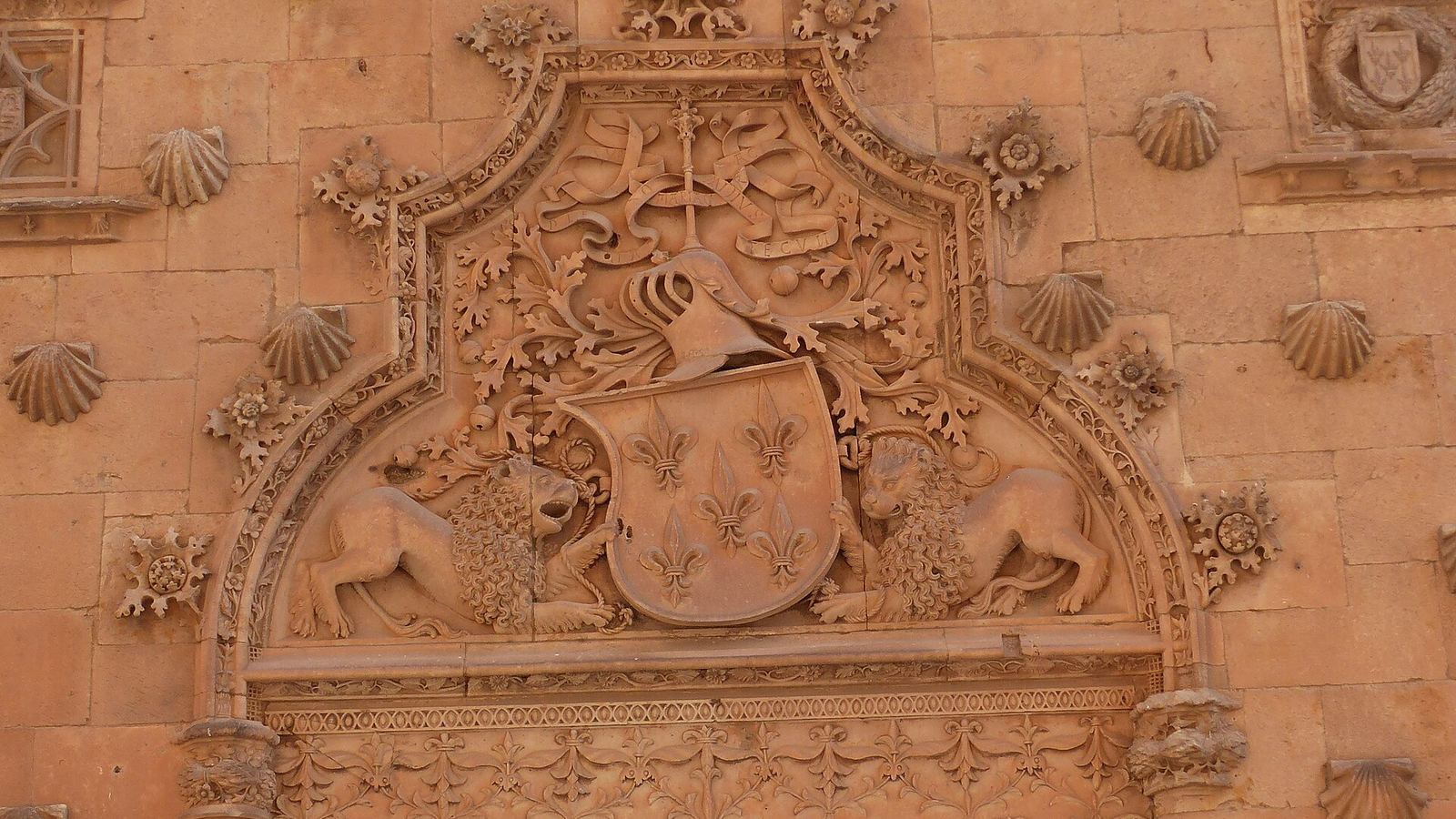
The windows each have a different frame of late Gothic tracery, and the lower ones keep wrought-iron grilles counted among the best Gothic ironwork in Spain. Over the door, lions hold the Maldonado arms with five fleurs-de-lis.
Inside, the courtyard has mixtilinear arches on the ground floor and an openwork stone balustrade on the upper gallery, with carved lions' heads holding the coats of arms of the family.
The top-rated monuments walk stops at the Casa de las Conchas with a live guide. See the tour →
The Scala Coeli towers of the Clerecía, opposite, look straight down on the house and its courtyard.
Free entry, open most days. A five-minute walk from everything in Salamanca's old town.